Street Food and Drink Minimal: Visual Strategy for Modern Culinary Branding
The intersection of culinary entrepreneurship and graphic design has created a distinct demand for visual assets that communicate flavor, mobility, and simplicity simultaneously. When business owners and designers search for Street Food and Drink Minimal aesthetics, they are not merely looking for decoration; they are seeking a functional communication tool. This specific design philosophy strips away unnecessary ornamentation to focus on the core value proposition of mobile gastronomy. Whether applied to a physical food truck wrap, a digital menu board, or a corporate catering proposal, the minimalist approach serves as a universal language that transcends cultural and linguistic barriers in the fast-paced street food sector.
Deconstructing the Visual Vocabulary of Mobile Gastronomy
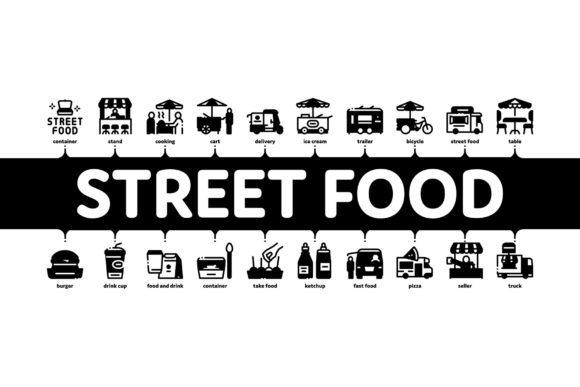
To effectively utilize street food imagery, one must understand the semiotics behind the specific icons that define the industry. The visual shorthand used in minimal vector art is carefully curated to trigger immediate recognition and appetite. A successful Street Food And Drink Minimal Infographic Web Banner Vector relies on four primary archetypes that signal distinct types of service and experience.
The Food Truck and Bicycle Dynamic
The silhouette of a food truck represents established mobility and substantial kitchen capacity. In minimal design, this is often rendered with clean geometric lines, emphasizing the vehicle's boxy structure without getting bogged down in mechanical details. This icon signals to the consumer that the vendor offers a full menu and professional-grade preparation. Conversely, the bicycle cart suggests agility, eco-friendliness, and niche specialization. When these two elements appear together in a composition, they illustrate the spectrum of mobile vending, from high-volume operations to artisanal micro-businesses. For urban planners and event organizers, distinguishing between these two visual markers helps in zoning and layout planning, ensuring that heavy vehicles and lightweight cycles are allocated appropriate space.
Carts, Stands, and Static Service Points
While trucks imply movement, carts and stands represent permanence within a temporary setting. The minimal depiction of a street stand focuses on the counter interface—the point of exchange between vendor and customer. This visual element is crucial for illustrating pop-up events, festival booths, and market stalls. In vector illustrations, the stand is often shown with an awning or a simple roofline, providing a visual anchor that suggests shelter and reliability. For designers creating wayfinding signage or event maps, the static stand icon differentiates fixed vendors from roaming units, aiding navigation and crowd flow management.
Burger and Sauce Bottles as Flavor Signifiers
Abstract representations of vehicles tell us how food is sold, but product icons tell us what is being sold. The burger remains the quintessential symbol of street food due to its recognizable layered geometry. In a minimal style, the burger is deconstructed into essential shapes: bun, patty, lettuce, and cheese. This abstraction allows the icon to remain appetizing without appearing photorealistic or messy. Accompanying sauce bottles add a dynamic element of customization and flavor variety. The inclusion of condiment imagery implies choice and personalization, key psychological drivers for street food consumers. When used in web banners or app interfaces, these icons serve as quick-scan categories, allowing users to filter options instantly based on dietary preferences or cravings.
Technical Formats and Workflow Integration
The utility of street food graphics extends beyond their aesthetic appeal; it is deeply rooted in file format versatility. Professional resources typically offer both JPG and EPS formats, each serving a distinct purpose in the production workflow. Understanding when and how to deploy these formats is essential for maintaining brand integrity across different media.
- EPS (Encapsulated PostScript): This vector-based format is the master file for any serious design project. Because it uses mathematical paths rather than pixels, an EPS file can be scaled infinitely without loss of quality. This is non-negotiable for large-format printing such as food truck wraps, vinyl decals, and outdoor banners. Designers can also open EPS files in Adobe Illustrator or CorelDRAW to modify colors, adjust line weights, or isolate specific elements like the catering service illustration for custom compositions.
- JPG (Joint Photographic Experts Group): While raster-based, high-resolution JPGs are indispensable for digital applications. They are optimized for web performance, social media posts, and digital menus where file size impacts load times. A pre-rendered JPG of a Street Food And Drink Minimal Infographic Web Banner Vector allows non-designers to quickly implement professional visuals into presentations, blogs, or email newsletters without requiring specialized vector software.
Maintaining access to both formats ensures that a brand’s visual identity remains consistent whether it appears on a 50-foot trailer or a 5-inch smartphone screen. This technical flexibility supports the omnichannel nature of modern food businesses, which must maintain a cohesive presence across physical and digital touchpoints.
Strategic Applications Across Industries
The relevance of minimal street food vectors extends far beyond the food vendors themselves. These assets have become foundational elements for a diverse ecosystem of professionals who support, regulate, or study the mobile food industry.
Catering Service Illustration for B2B Proposals
Corporate catering has evolved from buffet lines to experiential food stations. Catering companies utilize catering service illustrations in pitch decks and contracts to visualize the setup before the event occurs. A minimal vector illustration can clearly communicate the footprint required for a taco stand versus a coffee cart, helping venue managers assess spatial requirements. Furthermore, these clean visuals convey professionalism and hygiene, addressing corporate clients' concerns about safety and organization. By replacing cluttered photographs with sleek diagrams, caterers can focus the client’s attention on logistics and menu variety rather than distracting background details.
Educational and Research Visualization
Academics and researchers studying urban sociology, public health, or small business economics frequently require neutral, standardized imagery to present data. Photorealistic images can introduce bias or copyright complications in academic publishing. Minimal vectors provide a sterile, unbiased representation of street food infrastructure. When illustrating statistical trends regarding vendor density, nutritional access, or economic impact, researchers use these icons to create clear infographics that prioritize data over aesthetics. The uniformity of minimal style ensures that the viewer focuses on the information being presented rather than the artistic interpretation of individual vendors.
Digital Product and App Development
Developers building food delivery platforms, event discovery apps, or POS systems rely on consistent iconography for user interface (UI) design. A Street Food And Drink Minimal Infographic Web Banner Vector often contains a library of matching icons that ensure visual harmony throughout an application. Consistency in stroke width, corner radius, and color palette reduces cognitive load for users navigating complex menus. For hobbyists and indie developers, accessing pre-made vector packs accelerates the prototyping phase, allowing them to test user flows with professional-looking assets before investing in custom illustration.
Design Principles for Effective Implementation
Simply possessing these assets does not guarantee effective communication. The application of minimal street food graphics requires adherence to specific design principles to maximize their impact. Negative space is perhaps the most critical component. Minimalism thrives on breathing room; overcrowding a banner with too many burger icons or sauce bottles defeats the purpose of the style. Designers should allow ample margin around each element to let the eye rest and process the information sequentially.
Color psychology also plays a pivotal role. While the forms are minimal, the color choices carry significant weight. Warm tones like reds, oranges, and yellows are traditionally associated with appetite and energy, making them ideal for burger and sauce iconography. Cooler tones like greens and blues may be reserved for beverage icons or health-focused carts to signal freshness and hydration. When adapting a vector pack, modifying the color scheme to align with specific brand guidelines or seasonal campaigns is a standard practice that maintains the structural benefits of minimalism while injecting necessary personality.
Furthermore, context dictates complexity. A web banner intended for hero-section display may warrant a more detailed composition featuring the full range of trucks, bikes, and stands. However, a favicon or app button requires the distillation of that same concept into a single, bold glyph. The true value of a comprehensive vector pack lies in its modularity; the ability to extract the food truck and bicycle as standalone elements or combine them into a panoramic scene depending on the canvas size and communication goal.
Navigating Licensing and Customization
For business owners and creators, understanding the licensing and editability of these assets is a practical necessity. Vector files (EPS) offer the unique advantage of customization. A generic street food illustration can be transformed into a branded asset by integrating specific company colors, adding text overlays, or modifying the products depicted to match actual menu items. This adaptability makes minimal vectors a cost-effective alternative to commissioning bespoke illustrations from scratch.
However, users must remain vigilant regarding licensing terms. Commercial use rights vary significantly between free repositories and premium marketplaces. Ensuring that the selected Street Food and Drink Minimal assets are cleared for commercial application protects businesses from legal exposure. Additionally, when modifying EPS files, it is best practice to save the customized version as a new file, preserving the original master for future iterations. This workflow discipline ensures long-term asset viability and prevents the degradation of source material through repeated editing.
Ultimately, the power of minimal street food graphics lies in their ability to bridge the gap between operational reality and consumer perception. They translate the chaotic, sensory-rich world of street vending into organized, accessible visual information. Whether facilitating a research presentation, guiding a hungry tourist through a festival, or defining the brand identity of a new catering venture, these design elements serve as the silent ambassadors of the mobile food economy. Their continued evolution reflects the maturation of the industry itself, moving from novelty to essential infrastructure, represented with clarity, precision, and intentional simplicity.