Telegraph Social Media Presentation: A Versatile Framework for Modern Visual Storytelling
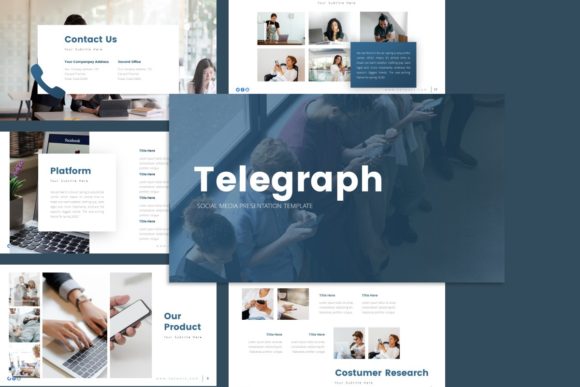
In the current digital landscape, the distinction between social media content and formal corporate communication has blurred significantly. Audiences expect the same level of visual polish in a LinkedIn carousel or an Instagram story as they do in a boardroom pitch deck. The Telegraph Social Media Presentation template emerges as a strategic response to this convergence, offering a unified visual language that bridges the gap between dynamic social engagement and professional business documentation. Understanding how to leverage such a comprehensive tool requires looking beyond its aesthetic appeal to examine its structural utility across diverse professional sectors.
Cross-Industry Applications and Strategic Relevance
The primary strength of the Telegraph Social Media Presentation lies in its adaptability. While many templates are niche-specific, this framework is engineered to serve a broad spectrum of users without requiring extensive redesign. This versatility is not accidental; it is a result of modular design thinking that prioritizes content hierarchy over rigid styling.
Creative Agencies and Portfolios
For creative professionals, the challenge often involves showcasing work without the presentation format overshadowing the portfolio pieces themselves. The Telegraph template addresses this through clean layouts and ample negative space. Creative agencies can utilize the 35 included slides to construct case studies that flow logically from problem identification to visual solution. The pixel-perfect illustrations serve as subtle accents rather than distractions, ensuring that photography and design work remain the focal point. When presenting to potential clients, this balance demonstrates professionalism while allowing the agency's unique voice to resonate.
Corporate Profiles and Business Communication
In corporate environments, consistency is paramount. Internal communications, quarterly reviews, and stakeholder updates often suffer from disjointed visuals when different departments use disparate tools. By adopting a master slide-based system like Telegraph, organizations can maintain brand integrity across all touchpoints. The handcrafted infographics included in the package allow complex data to be translated into digestible visual formats. This is particularly valuable for annual reports or internal strategy sessions where clarity directly impacts decision-making efficiency. The ability to resize and edit all graphics ensures that these assets remain relevant even as corporate branding evolves.
Startups and Pitch Decks
Startups face the unique pressure of needing to look established while remaining agile. Investors evaluate pitch decks not just on content, but on the team's ability to communicate clearly and professionally. The Telegraph Social Media Presentation provides a structured narrative arc suitable for fundraising. With dedicated slides for market analysis, financial projections, and team introductions, founders can focus on refining their value proposition rather than wrestling with alignment tools. The drag-and-drop picture placeholders streamline the process of updating team photos or product shots, which is essential for startups that iterate rapidly.
Technical Architecture and Customization Workflow
A template is only as effective as its underlying technical construction. The Telegraph Social Media Presentation is built upon a foundation of Master Slides within PowerPoint (.PPTX). This architectural choice is significant for long-term usability and scalability. Unlike templates that rely on grouped objects or locked layers, a master slide system allows for global changes. If a user needs to update a logo, change a color palette, or adjust font typography across all 35 slides, they can do so by editing the master rather than formatting individual slides. This reduces the time spent on maintenance and minimizes the risk of formatting errors.
Vector Graphics and Scalability
Resolution independence is a critical factor in modern presentations that may be viewed on anything from a smartphone screen to a 4K projector. All graphic elements in this template are vector-based. This means that illustrations, icons, and shapes can be scaled infinitely without pixelation or loss of quality. For users creating content destined for high-resolution social media feeds or large-format printing, this feature eliminates the need to source external assets. Furthermore, because these vectors are native to PowerPoint, every anchor point and color fill remains editable, granting designers full control over the visual output.
Content Management via Placeholders
Ease of use is defined by how quickly a user can swap demo content for real assets. The Telegraph template utilizes intelligent picture placeholders. Rather than cropping images manually or dealing with aspect ratio distortions, users can simply drag and drop their media into designated zones. The template automatically masks and fits the image according to the pre-designed layout. This functionality is particularly beneficial for non-designers who need to produce high-quality visuals under tight deadlines. It democratizes design, allowing marketers, educators, and researchers to achieve professional results without advanced graphic design training.
Optimizing Visual Narratives for Digital Platforms
The specific designation of "Social Media" in the title suggests a departure from traditional 16:9 landscape constraints. While the template functions perfectly for standard presentations, its design logic accommodates the vertical and square formats prevalent on platforms like Instagram, TikTok, and LinkedIn. This requires a different approach to information density and text sizing.
Information Hierarchy in Micro-Content
Social media audiences have shorter attention spans than boardroom audiences. The handcrafted infographics in the Telegraph Social Media Presentation are designed with this cognitive load in mind. They prioritize key metrics and simplify complex processes into linear or circular flows that can be understood in seconds. When adapting these slides for social sharing, users should focus on one core message per slide. The template’s variety of 35 slides provides enough options to create multi-part carousels that encourage swiping and engagement, turning a static presentation into an interactive storytelling experience.
Typography and Readability Standards
Readability on mobile devices dictates strict typographic standards. The font choices and sizing hierarchies within this template are calibrated to ensure legibility at small scales. Headers are distinct from body copy, and contrast ratios are maintained to meet accessibility guidelines. When customizing the template, it is advisable to adhere to these established hierarchies. Deviating too far from the recommended font sizes can compromise the user experience, especially when the content is consumed on smaller screens. The template serves as a guardrail, helping users avoid common pitfalls like overcrowding slides with text or using low-contrast color combinations.
Implementation Best Practices and Asset Management
Maximizing the return on investment from a premium template involves disciplined asset management and adherence to best practices. While the Telegraph Social Media Presentation includes a comprehensive documentation file, understanding the broader context of presentation design enhances the final output.
- Leverage the Documentation: The included documentation file is not merely a technical manual; it is a guide to the designer's intent. Reviewing this before starting a project can reveal hidden features or intended workflows that save time.
- Source High-Quality Imagery: Since demo images are for preview purposes only, the quality of the final presentation depends entirely on the user's assets. Investing time in sourcing or creating high-resolution, thematically consistent photography is essential. The template’s placeholders will highlight poor-quality images, so resolution matters.
- Maintain Vector Integrity: When editing the included vector icons, avoid rasterizing them unless absolutely necessary. Keeping them as vectors ensures the file size remains manageable and the quality stays crisp across all export formats.
- Utilize the Icon Set: The included vector icon set provides a cohesive visual vocabulary. Mixing these with external icon packs can create stylistic dissonance. Sticking to the provided set ensures a unified look throughout the 35 slides.
- Export Considerations: For social media use, exporting as high-quality PNG or JPEG sequences is often preferable to PDF. For corporate use, keeping the native .PPTX file allows for future edits. Understanding the end destination of the content should dictate the export settings.
Evaluating Design Efficiency and Professional Impact
The decision to adopt a structured template like Telegraph Social Media Presentation is ultimately an efficiency calculation. Building a 35-slide deck from scratch involves dozens of hours of layout design, color selection, and typography testing. By utilizing a pre-engineered system, professionals reclaim that time for content strategy and audience analysis. However, efficiency should not come at the cost of authenticity. The template provides the skeleton, but the flesh must be unique to the presenter.
Successful implementation requires treating the template as a starting point rather than a finished product. The easy customizable contents are designed to be molded. Changing background colors, adjusting infographic data points, and rewriting placeholder text are mandatory steps to ensure the presentation aligns with specific brand identities. The "handcrafted" nature of the infographics implies a level of detail that automated chart generators cannot replicate, but this detail only shines when populated with accurate, relevant data.
Furthermore, the cross-compatibility of the .PPTX format ensures that collaboration remains seamless. Team members using different versions of PowerPoint or operating systems can generally access and edit the file without catastrophic formatting loss. This interoperability is crucial for distributed teams and agencies working with multiple clients. The inclusion of master slides also facilitates the creation of custom theme files, allowing organizations to extract the core design DNA of Telegraph and apply it to future documents, emails, and reports, thereby extending the value of the initial acquisition well beyond a single project.
Ultimately, the Telegraph Social Media Presentation represents a shift toward hybrid visual communication tools. It acknowledges that modern professionals do not exist in silos; they are simultaneously creators, analysts, storytellers, and strategists. By providing a robust, scalable, and aesthetically refined framework, it enables these diverse roles to communicate with greater impact and less friction. Whether used for a personal portfolio, a startup pitch, or a corporate social media campaign, the template’s true value is realized when users understand its structural capabilities and apply them with strategic intent.