Digital Economy and E-business Minimal: Visualizing Modern Commerce
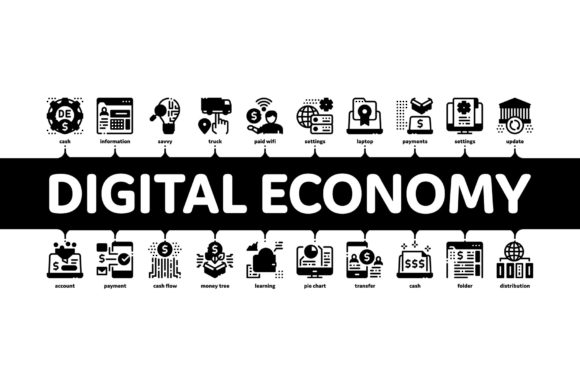
In an era where attention spans are fleeting and digital noise is at an all-time high, clarity has become the ultimate currency for online businesses. The concept of Digital Economy and E-business Minimal represents more than just an aesthetic choice; it is a strategic communication framework designed to cut through complexity. For business owners, content creators, and marketers, adopting a minimal approach to visual storytelling is not about removing elements until nothing is left, but rather about distilling complex economic concepts into their most potent, understandable forms. This philosophy applies directly to how we utilize assets like the Digital Economy And E-business Minimal Infographic Web Banner Vector to convey sophisticated ideas regarding e-commerce, research, and logistics without overwhelming the viewer.
The Strategic Value of Minimalist Business Visualization
When discussing the digital economy, we are often grappling with abstract systems: data flows, global supply chains, mobile transactions, and cloud infrastructure. Translating these intangible processes into visual media requires a disciplined hand. A cluttered infographic or a busy web banner can inadvertently signal confusion or outdated practices. Conversely, a design rooted in Digital Economy and E-business Minimal principles signals efficiency, modernity, and user-centric thinking.
The primary purpose of this minimalist approach is cognitive ease. When a potential client or consumer lands on a webpage featuring a clean illustration of a computer and cell phone interacting seamlessly, they instantly understand the premise of cross-platform commerce. They do not have to decode the image; the image decodes the business model for them. This immediate comprehension is vital in sectors like idea research and cargo delivery, where trust is built on transparency and simplicity. By utilizing vector formats such as EPS and JPG, businesses ensure that this clarity is maintained across all devices, from large desktop monitors to small smartphone screens, preserving the integrity of the message regardless of scale.
Core Characteristics of Effective E-Business Imagery
To truly leverage the power of minimal design in the digital economy space, one must understand what makes these visuals effective. It is not merely about using white space; it is about intentional symbolism.
- Semantic Clarity: Every icon must serve a narrative purpose. A truck icon in a minimal style shouldn't just look like a vehicle; it should represent the broader concept of "logistics" or "fulfillment" within the digital ecosystem.
- Scalable Vector Architecture: The use of EPS formats ensures that lines remain crisp and colors remain consistent. In e-business, pixelation suggests negligence, while sharp vectors suggest precision.
- Cohesive Color Psychology: Minimal palettes often rely on two or three core colors to guide the eye. Blue might denote trust in financial transactions, while green could signify sustainable cargo delivery or successful research outcomes.
- Negative Space as Active Element: In Digital Economy and E-business Minimal designs, empty space is not wasted space. It provides the breathing room necessary for the viewer to process information about complex topics like e-commerce algorithms or market research data.
Practical Applications Across Industries
The versatility of assets like the Digital Economy And E-business Minimal Infographic Web Banner Vector lies in their adaptability. While the core theme remains consistent, the application varies significantly depending on the user's specific role within the digital landscape.
For E-Commerce Platforms and Retailers
Online retailers face the challenge of explaining backend processes to frontend consumers. How does a customer understand the journey from "idea research" to "cargo delivery"? Minimalist illustrations bridge this gap. A clean, linear graphic showing the progression from a lightbulb (idea) to a shopping cart (e-commerce) to a package (delivery) creates a narrative arc that reassures customers. These visuals work exceptionally well in "How It Works" sections, checkout pages, and shipping policy explanations, reducing support tickets by proactively answering visual questions.
For B2B Service Providers and Consultants
Consultants operating in the digital economy sector often sell expertise rather than physical goods. Their websites must convey authority and intellectual rigor. Using a Digital Economy and E-business Minimal aesthetic helps position these professionals as organized thought leaders. An infographic detailing market trends or digital transformation strategies benefits immensely from reductionism. When presenting data-heavy research, stripping away decorative flourishes allows the insights to take center stage. The inclusion of computer and cell phone illustrations in this context serves as a universal signifier of digital connectivity, grounding abstract consulting advice in tangible technology.
For Content Creators and Educators
Bloggers, course creators, and digital educators need to maintain engagement over long-form content. Text walls regarding the nuances of e-business can cause reader fatigue. Integrating minimal web banners acts as a visual palate cleanser that reinforces the topic. Because these assets are available in JPG format, they are easily optimized for fast loading times, which is crucial for SEO and user retention. A creator discussing the future of mobile commerce can use a stylized cell phone illustration to break up text, keeping the reader’s eye moving down the page while reinforcing the lesson visually.
Evaluating Suitability: When to Choose Minimal Over Complex
While the Digital Economy and E-business Minimal style is powerful, it is not a universal panacea. Professionals must evaluate whether this approach aligns with their specific communication goals. Understanding the strengths and limitations of this style prevents misapplication.
Strengths and Ideal Scenarios
This style excels when the goal is rapid comprehension and broad appeal. If your audience includes general consumers who may not be tech-savvy, minimalism removes barriers to entry. It is also superior for responsive web design; complex, detailed illustrations often lose definition on mobile devices, whereas minimal vectors retain their communicative power. Furthermore, this style ages gracefully. Trends in hyper-realistic 3D rendering come and go quickly, but clean, geometric minimalism tends to remain relevant for years, protecting your investment in branding assets.
Considerations and Limitations
However, there are scenarios where extreme minimalism may fall short. If your value proposition relies on technical specificity—for example, showcasing the intricate engineering of a new logistics robot or the detailed interface of a proprietary trading platform—a simplified illustration might feel reductive or generic. In such cases, the "minimal" aspect should be applied to the layout and color palette, but the subject matter itself may require higher fidelity. Additionally, because minimal stock vectors are widely accessible, there is a risk of visual homogeneity. Businesses using the Digital Economy And E-business Minimal Infographic Web Banner Vector should consider customizing colors or combining elements uniquely to avoid looking identical to competitors.
Technical Best Practices for Implementation
Owning the asset is only the first step; implementing it correctly determines its effectiveness. Whether you are working with the EPS source file or the ready-to-use JPG, technical execution matters.
- Format Selection: Always edit in EPS to maintain vector quality. Only export to JPG for final web deployment. Never upscale a JPG, as this introduces artifacts that undermine the "clean" aesthetic.
- Alt Text Optimization: For SEO, describe the image functionally. Instead of "minimal banner," use alt text like "Digital economy infographic showing mobile e-commerce and cargo delivery workflow." This aligns with people-first content principles by making the site accessible to screen readers.
- Contextual Integration: Ensure the illustration supports adjacent text. If the banner depicts idea research and cargo delivery, the surrounding copy should explicitly discuss innovation and logistics. Disconnected visuals create cognitive dissonance.
- Loading Performance: Minimal graphics should be lightweight. Compress JPGs without losing sharpness. Fast load times are a ranking factor and a conversion factor; a beautiful banner that delays page render defeats its own purpose.
The Future of Visual Communication in Digital Commerce
As the digital economy continues to expand, the volume of information we must process daily will only increase. In response, the trend toward Digital Economy and E-business Minimal visualization is likely to strengthen, not weaken. We are moving toward an era of "functional aesthetics," where beauty is defined by utility and clarity. The ability to visualize complex systems—from the initial spark of idea research to the final mile of cargo delivery—in a simple, elegant manner is becoming a core competency for modern businesses.
For professionals navigating this landscape, investing in high-quality, versatile assets like the Digital Economy And E-business Minimal Infographic Web Banner Vector is a practical step toward better communication. It allows brands to speak the visual language of the modern web: fast, clear, and universally understood. By focusing on usefulness rather than decoration, and by leveraging scalable formats like EPS and JPG, businesses can create digital environments that respect the user's time and intelligence. Ultimately, minimalism in e-business is not about saying less; it is about ensuring that what is said is heard, understood, and acted upon.