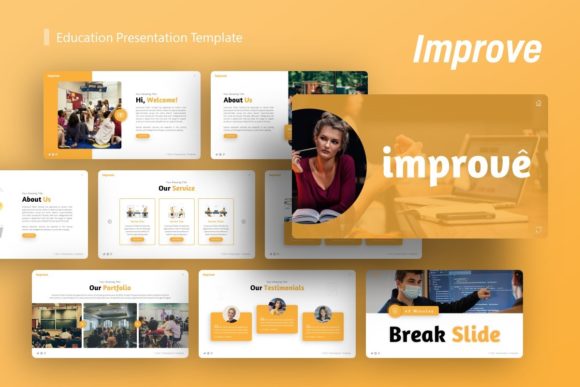
Presentation Template - Improve: A Structural Framework for Educational and Corporate Storytelling
In the modern landscape of digital communication, the distinction between educational content and corporate branding has become increasingly porous. Professionals across sectors are no longer satisfied with rigid, single-purpose slide decks that force a choice between aesthetic appeal and functional depth. The Presentation Template - Improve emerges as a response to this demand, offering a hybrid architecture designed to serve creative agencies, startups, educators, and individual portfolio builders simultaneously. Rather than functioning merely as a decorative skin, this template system operates as a comprehensive visual framework that prioritizes information hierarchy, editability, and cross-industry adaptability.
The Architecture of Master Slides and Global Consistency
At the core of any robust presentation system lies the concept of the Master Slide. For users unfamiliar with advanced PowerPoint mechanics, the master slide is the foundational layer that dictates global styling, typography, and layout grids across an entire deck. The Presentation Template - Improve leverages this feature extensively to ensure consistency without sacrificing flexibility. When a user modifies a color palette or font family within the master view, those changes propagate instantly across all 36 included slides. This technical foundation is critical for maintaining brand integrity, particularly in corporate and business environments where adherence to visual identity guidelines is mandatory.
This structural approach significantly reduces the cognitive load during the design process. Instead of formatting individual slides manually—a practice that often leads to misaligned elements and inconsistent spacing—users can focus entirely on content strategy. The handcrafted infographics included in the package are built upon these master foundations, meaning they inherit global styles while retaining their complex internal geometry. For researchers and educators presenting data-heavy material, this ensures that charts and diagrams remain visually cohesive with the rest of the narrative, preventing the disjointed appearance that often plagues academic or technical presentations.
Vector Scalability and Resolution Independence
A frequent pain point in presentation design is the degradation of visual quality when resizing elements or projecting onto high-resolution displays. This template addresses the issue through fully vector-based illustrations and icons. Unlike raster images which pixelate when enlarged, vector graphics in the Presentation Template - Improve maintain mathematical precision at any scale. This characteristic is particularly valuable for pitch decks and startup presentations, where materials may be viewed on everything from mobile devices during due diligence to large-format screens during investor demos.
The inclusion of a dedicated vector icon set further enhances this scalability. Icons serve as visual anchors that break up dense text and guide viewer attention. Because these assets are editable, users can adjust stroke weights, colors, and sizes to match specific contextual needs without resorting to external graphic design software. This self-contained ecosystem allows for rapid iteration, enabling teams to prototype different visual approaches during collaborative planning sessions without waiting for designer availability.
Cross-Sector Applications and Use Case Adaptation
The versatility of this template stems from its neutral yet sophisticated baseline design. While marketed with specific verticals in mind, its utility extends far beyond predefined categories. Understanding how different audiences leverage these 36 slides reveals the practical breadth of the system.
- Educational Institutions and EdTech: In learning environments, clarity supersedes decoration. The template’s infographic capabilities allow instructors to visualize complex processes, timelines, and comparative analyses. The "Improve Education" aspect of the naming convention reflects this pedagogical focus, providing layouts specifically structured for lesson plans, curriculum overviews, and student progress reports. The drag-and-drop picture placeholders facilitate the quick integration of case study imagery or historical references without breaking the slide layout.
- Creative Agencies and Portfolios: For visual professionals, the presentation itself serves as a testament to design sensibility. The template provides ample negative space and grid-aligned image placements that let photography and creative work take center stage. Personal portfolios benefit from dedicated biography and skill-set slides that avoid the cluttered aesthetic of traditional resumes, presenting professional narratives with the polish of a client deliverable.
- Startups and Pitch Decks: Fundraising presentations require a delicate balance of storytelling and data validation. The template includes specific slide archetypes for problem-solution framing, market sizing, team introductions, and financial projections. Because all graphics are resizable and editable, founders can customize standard infographic templates to reflect unique business models rather than relying on generic stock visuals that savvy investors might recognize from other decks.
- Corporate Reporting and Internal Comms: Large organizations require standardized tools to ensure departmental alignment. The master slide functionality allows IT or brand teams to deploy a locked-down version of the Presentation Template - Improve that permits content editing while restricting layout changes. This governance model maintains professional standards across thousands of internal presentations while still empowering individual contributors to communicate effectively.
Balancing Visual Density with Cognitive Load
Effective presentation design is ultimately an exercise in information management. The 36-slide count in this template is not arbitrary; it represents a curated library of layout patterns that address distinct communicative functions. From full-bleed image slides for emotional impact to multi-column text layouts for detailed explanation, each slide type serves a specific purpose in managing audience attention.
Users must exercise discipline when utilizing such a comprehensive toolkit. The availability of numerous infographic options does not necessitate their use on every slide. Best practices suggest alternating between high-density information slides and low-density breathing room slides to maintain engagement rhythm. The template supports this pacing through varied background treatments and transition-ready layouts. For educational presenters, this might mean following a complex diagram with a simple quote or key takeaway slide. For business presenters, it could involve pairing a data chart with a qualitative customer testimonial. The template facilitates these rhetorical shifts without requiring custom design intervention.
Technical Implementation and Asset Management
Adopting a new presentation template involves more than simply opening a file; it requires understanding the asset ecosystem. The Presentation Template - Improve ships with a .PPTX file, documentation, and vector icons, but users should note important distinctions regarding media assets. All images shown in preview demonstrations serve exclusively as placeholders and are not included in the downloadable files. This industry-standard practice prevents licensing complications and encourages users to source authentic, relevant imagery for their specific context.
The drag-and-drop picture placeholder system streamlines this customization process. Rather than cropping and positioning images manually, users can insert photos directly into pre-configured frames that automatically apply masking and alignment. This feature is particularly time-saving for photographers and agencies managing large volumes of visual content. The documentation file serves as an essential reference for unlocking advanced features, explaining how to modify master slides, update color themes, and troubleshoot common compatibility issues across different versions of Microsoft PowerPoint.
Customization Workflows for Non-Designers
One of the primary value propositions of this template is its accessibility to users without formal design training. The "easy customizable contents" claim rests on several user-friendly mechanisms. Text boxes are linked to style definitions, meaning font size and weight adjustments follow typographic hierarchies established by professional designers. Color swatches are organized into theme palettes, allowing for instant rebranding through the Design tab rather than manual recoloring of individual shapes.
For users seeking deeper customization, the editable nature of all graphics opens significant possibilities. Shapes can be ungrouped to reveal constituent parts, allowing for modification of individual elements within complex infographics. This level of access transforms the template from a static product into a dynamic design kit. However, this power requires careful handling; excessive modification of core geometric structures can compromise the visual balance originally intended by the creator. Users are advised to duplicate and experiment on copy slides before altering master elements, preserving a clean fallback option throughout the development process.
Strategic Considerations for Long-Term Utility
Investing time in learning a comprehensive template system yields compounding returns when approached strategically. Organizations and individuals who adopt the Presentation Template - Improve as a long-term communication platform rather than a one-off solution develop institutional memory and efficiency. Repeated use builds familiarity with the slide library, reducing creation time for subsequent presentations. Brand consistency improves naturally as teams internalize the visual language embedded in the master slides.
From an SEO and discoverability perspective within organizational knowledge bases, standardized templates also improve searchability and categorization. When all presentations follow similar structural conventions, stakeholders can locate specific information types more efficiently. The template’s logical organization supports this metadata-friendly approach to content creation.
Ultimately, the effectiveness of any presentation tool depends on the intentionality of its user. The Presentation Template - Improve provides the vocabulary and grammar of professional visual communication, but the narrative remains the responsibility of the presenter. By understanding the technical foundations, respecting the design principles, and adapting the flexible components to authentic content needs, users across education, business, and creative fields can transform standard slide decks into compelling instruments of persuasion and instruction. The template succeeds not by imposing a singular aesthetic, but by providing a resilient infrastructure capable of supporting diverse communicative objectives with equal proficiency and polish.